23-24.06.2025
INTERNATIONAL SYMPOSIUM „REIMAGINING WESTERN CIVILIZATION”
Adam Chmielecki (Ph.D.), representative of the Programme Council of the Intermarium Institute, took part in the international symposium „Reimagining Western Civilisation. Historical Foundations, Contemporary Challenges, and Future Directions”, which was held online on 23 and 24 June 2025. The event was organised by the European Academy of Science and Arts (EASA) in Salzburg (Austria) and Alma Mater Europaea University in Maribor (AMEU, Slovenia).
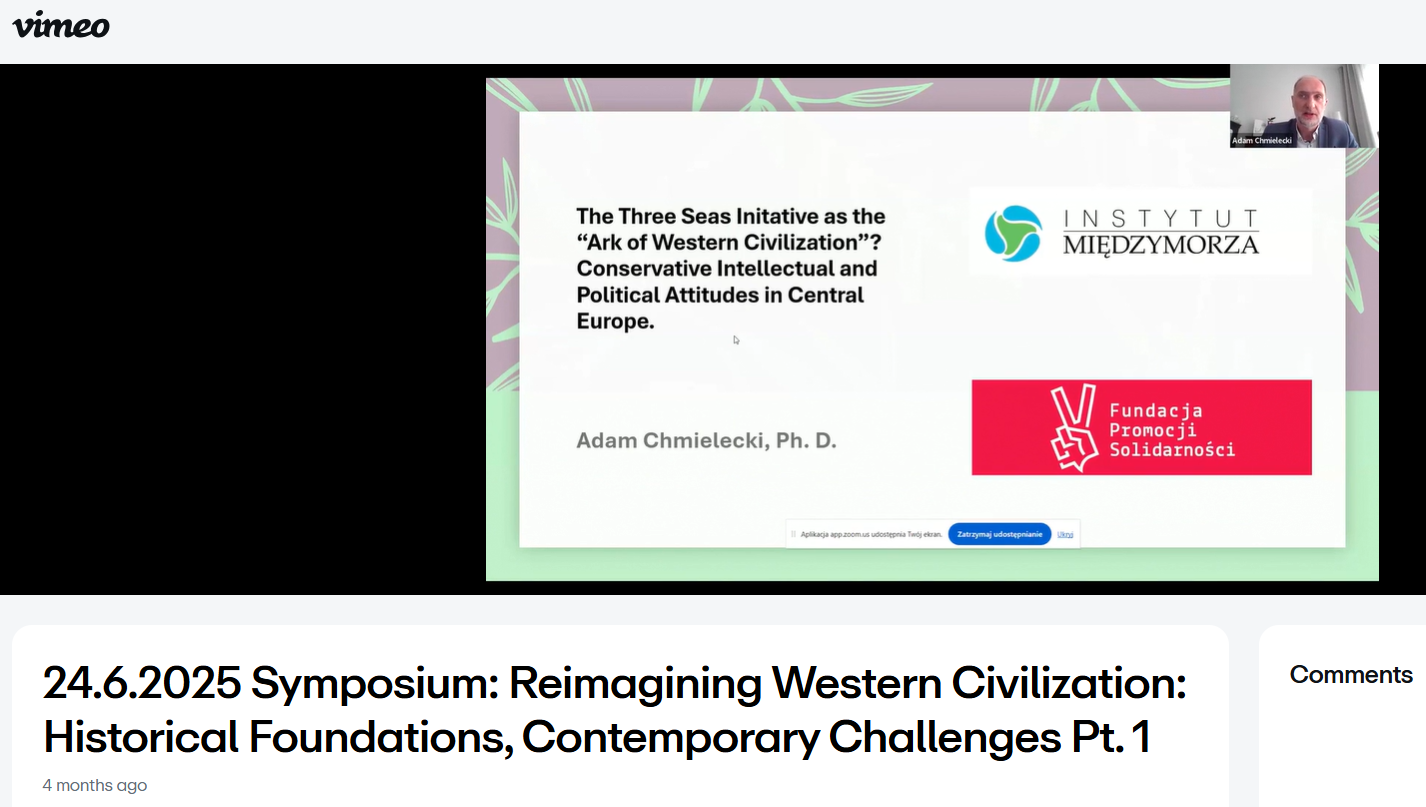
Adam Chmielecki delivered a paper entitled „The Three Seas Initiative as the »Ark of Western Civilisation«? An analysis of the intellectual attitudes and political actions of conservative circles in Central European countries towards The Three Seas Initiative”.
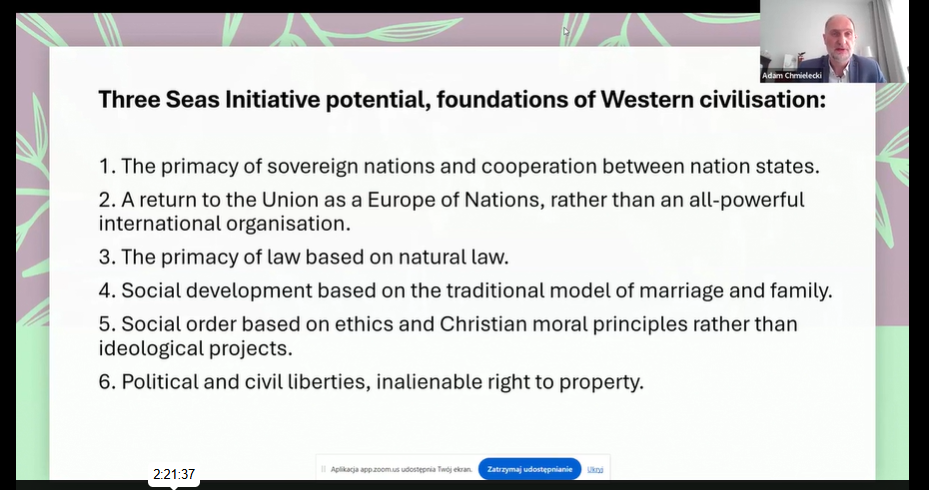
In his speech, Adam Chmielecki presented the history, specificity and potential of the countries and nations of the Three Seas Initiative, which was established in 2015 on the initiative of the presidents of Croatia and Poland. He emphasised that although the initiative is not conditioned by political views, it is impossible not to notice that cooperation within the format works better the more conservative the views of the leaders of individual countries, especially presidents, are at a given time – it is a format of cooperation at the level of heads of state.
Conservative (illiberal) circles in the European Union perceive the Three Seas Initiative, which celebrates its tenth anniversary in 2025, as a platform for cooperation between the countries and societies of the region, which stands out from other European Union members due to its greater social attachment to traditional Western civilisational and cultural values (including political culture): religiosity (Christian), moral norms based on faith, the traditional family model, individual freedom, the sovereignty of nation states, and a classical education and upbringing programme.
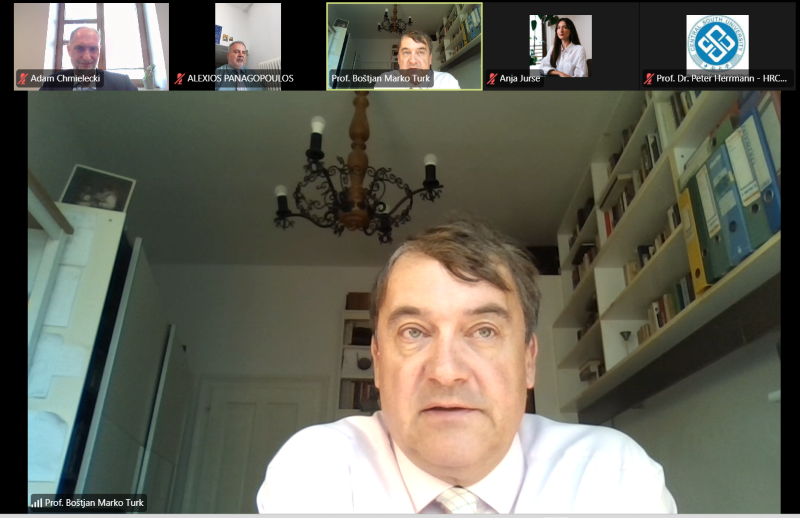
The two-day symposium was attended by researchers of Western civilisation from various disciplines (history, economics, philology, philosophy, literary studies, law, religious studies, theology), as well as business and political practitioners and representatives of various fields of art, including from Austria, Croatia, Greece, Finland, Germany, Poland, Slovenia and the United States, including Prof. Jernej Barbič, Prof. Vlado Dimovski, Prof. Peter Herrmann, Prof. Arto Lahti, Prof. Wolfgang Spickermann, Prof. Boštjan Marko Turk and Prof. Žiga Turk.